
Every marketing platform now promises AI. Adopting it and creating business value from it are two very different things.
A company can subscribe to multiple AI platforms, automate dozens of tasks and still see little improvement in how it operates. Technology alone doesn't create an advantage. The advantage comes from identifying the right problems, connecting the right systems and eliminating work that slows people down.
At eLab Communications, we see AI as part of a broader digital strategy. Its greatest value is frequently behind the scenes: helping teams respond faster, keep information organized and make better decisions without sacrificing creativity or human judgment.
Start With the Business Problem, Not the AI Tool
The wrong question is, "Which AI platform should we use?"
The better question is, "What's taking too much time, creating unnecessary work or causing us to miss opportunities?"
A restaurant may struggle to keep up with private-dining inquiries. A professional services company may receive sales, billing and support requests through the same contact form. A marketing team may spend hours pulling information from different platforms before it can begin analyzing performance.
Each problem deserves a clear workflow before anyone introduces AI.
Sometimes the answer is intelligent classification or automation. Other times, a better form, a straightforward integration or a more organized content management system will solve the problem with less complexity.
Start with the friction. Then choose the technology.
Automate Repetition, Keep Judgment Human
Repetitive tasks are usually the best starting point for automation.
Sorting inquiries, preparing reports, organizing records, extracting information from documents and triggering routine notifications follow patterns that software can handle consistently.
AI becomes useful when those patterns involve language or information that traditional rules struggle to interpret.
For example, an incoming message might contain a private-event request, a question about an existing reservation and an accessibility requirement. AI can help identify the different needs, while established workflows determine where the request goes and what happens next.
Not every decision should be automated, however.
Brand positioning, sensitive customer communications, contractual commitments and important creative decisions require experience and accountability. AI can prepare information or suggest options, but a person should remain responsible for consequential decisions.
Lead Management: Where Faster Responses Matter
A potential customer submits an inquiry through a website. What happens next?
On many websites, the answer is surprisingly simple: an email arrives somewhere, and someone eventually responds.
That leaves room for missed messages, delayed follow-ups and inconsistent handling.
A stronger system captures the inquiry, validates the information, records it reliably and routes it to the right team. AI can assist when the request needs interpretation, but the essential workflow should function even when an AI service is unavailable.
In the restaurant websites we've developed, dedicated private-dining and group-event inquiry forms collect information such as event dates, party sizes and guest requirements. Those submissions are stored and routed through defined notification workflows rather than relying solely on a general contact inbox.
The result is a more organized process that also creates opportunities for future automation.
Dependable workflows, clear routing and a path to a person matter more than the AI model itself. AI and automation should strengthen the customer experience, not introduce another point of failure.
CRM Automation: Make Customer Information Useful
A customer relationship management system should do more than store names and email addresses.
It should help a business understand relationships, maintain accurate records and recognize when follow-up is needed.
Automation can connect website inquiries with customer records, organize interactions, flag missing information and trigger approved communications.
For a hospitality business, that might involve managing event inquiries or customer preferences. For an agency, it might mean connecting new project requests to an internal workflow. For an event organizer, it could mean coordinating registration records with attendee communications.
The important issue is how that information is collected and used.
Customer data needs clear ownership, consent controls and sensible retention practices. Automated communications should respect the permissions people have provided.
Well-designed email and CRM systems make customer information more useful without creating unnecessary administrative work.
AI-Assisted Content Without Losing Your Brand
AI has made content production faster. It has not made good creative direction less important.
A business can generate dozens of articles, captions and marketing concepts in minutes. That doesn't mean the material is accurate, distinctive or worth publishing.
The weakness becomes obvious when every brand begins sounding alike.
A restaurant's personality should come from its actual food, atmosphere and guest experience. A luxury automotive event needs a different editorial voice from a nonprofit organization. A technology company needs to explain complex capabilities without burying readers in jargon.
AI can help organize research, prepare outlines, transcribe interviews, adapt approved material and accelerate early drafts. But someone still needs to verify the information, develop the perspective and make the final editorial decisions.
At eLab Communications, content production connects photography, video, copywriting, design and digital strategy. The work is stronger when those disciplines inform one another.
AI belongs inside that process as a production tool, not as a substitute for understanding the brand.
APIs Connect AI to Real Business Workflows
Many businesses already have capable software. Their problem is that the systems operate independently.
A website collects inquiries. A CRM manages contacts. An email platform handles communications. Another application manages events, reservations or internal tasks.
Employees end up transferring information between them.
API integrations connect these systems so information can move securely and consistently.
AI can then assist with work that requires interpretation, such as categorizing a request or summarizing a conversation.
Consider an event registration process. The system can validate a submission, update the attendee record, send a confirmation and notify staff when special assistance is requested. Those steps should follow dependable rules.
AI might help interpret an unusual message, but it should not invent a payment confirmation, change a reservation without authorization or make commitments the business cannot fulfill.
The strongest automation combines flexible intelligence with reliable software engineering.
Customer Service: Automate the Routine
Customer-facing AI assistants can help businesses answer common questions, collect information and direct requests to the right place.
For a restaurant, that might mean explaining hours, parking or private-dining options. For a professional services company, it might mean distinguishing a new project inquiry from a billing question or technical support request.
These systems are especially useful when a business receives inquiries outside normal operating hours.
Customers need to know when they're interacting with automation, and reaching a person must remain straightforward.
A successful assistant doesn't need to handle every conversation. It needs to provide accurate help, recognize its limits and make the overall experience easier.
Analytics: Finding Signals in Business Data
Marketing teams rarely suffer from a shortage of data. The challenge is understanding what deserves attention.
Website analytics, search performance, advertising platforms and customer interactions generate information that can reveal opportunities or problems.
AI-assisted analysis can help organize that information, summarize trends and identify unusual changes.
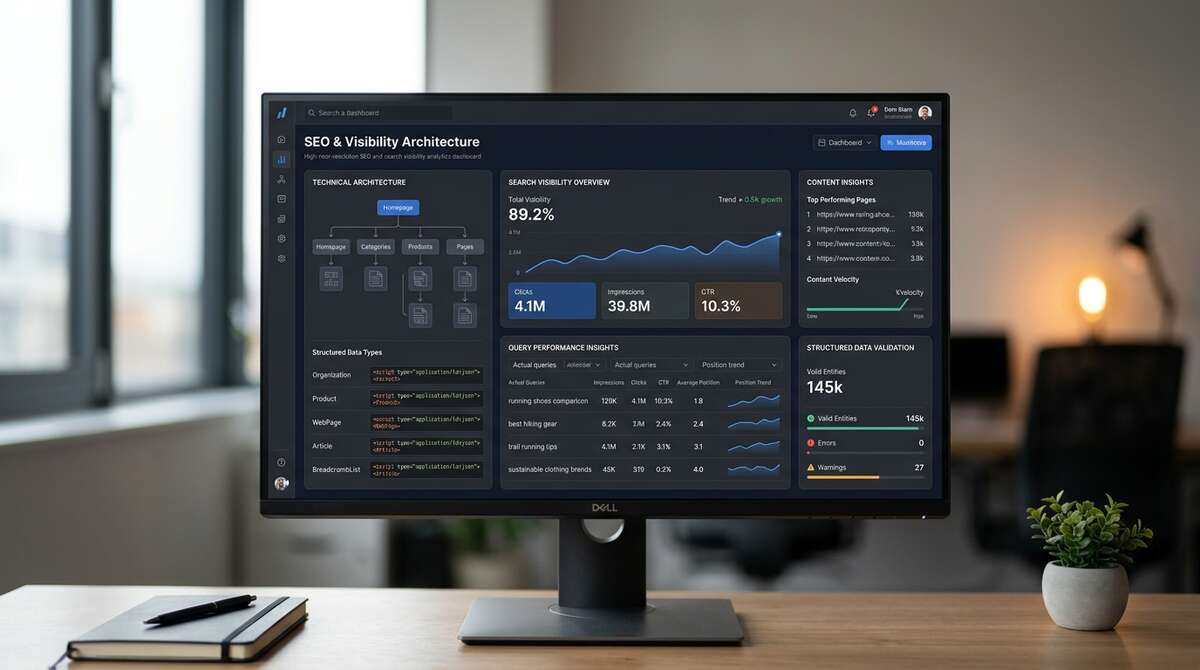
We developed eLab SEO Intelligence to bring Google Search Console data, search performance history and technical website information into a more consistent reporting environment. Instead of reviewing disconnected reports, we can examine performance trends, investigate changes and prioritize improvements using a common set of data.
The reporting itself must remain grounded in verifiable source data. An AI-generated explanation should never be confused with a measured result.
For example, declining search traffic might be caused by indexing problems, competitive changes, seasonality or several factors at once. A system can flag the decline, but identifying the cause requires investigation.
Good analytics helps people ask better questions and act on evidence.
AI Search Is Changing How Customers Find Businesses
Search behavior is evolving beyond the familiar list of blue links.
People increasingly encounter AI-generated answers through Google's AI Overviews and use services such as ChatGPT and Perplexity to research businesses, compare services and explore recommendations.
For brands, this introduces another consideration: information may be summarized by an AI system before a potential customer visits the website.
That makes clear, accessible and trustworthy content increasingly important.
A business should explain what it does, where it operates, whom it serves and what distinguishes its services. Important information should be available in crawlable page content rather than hidden entirely inside images, PDFs or interactive elements that search systems struggle to interpret.
Accurate business information, relevant structured data, credible examples and consistent details across websites and business listings all help establish a clearer digital presence.
None of these practices guarantees inclusion in an AI-generated answer. AI platforms use different retrieval and ranking systems, and businesses cannot control every recommendation.
But the fundamentals of SEO and search visibility remain essential: technical accessibility, useful content, clear site architecture and evidence that supports what a business claims.
Our discussion of hospitality website design illustrates this principle. A restaurant website with accessible menus, accurate hours, clear reservation information and well-organized content serves both human visitors and systems trying to understand the business.
AI-driven discovery adds another reason to make websites genuinely useful.
Measure Outcomes, Not AI Activity
The number of automated tasks is not a business result.
What matters is whether the automation improves something the organization values.
Useful measurements include:
Time required to process an inquiry
Percentage of requests routed correctly
Reduction in repetitive administrative work
Accuracy of customer records
Customer response and resolution times
Conversion rates for qualified inquiries
Employee time available for higher-value work
These measurements need a baseline.
If a workflow saves ten minutes but creates fifteen minutes of correction work, it hasn't improved efficiency. If AI accelerates content production but the resulting material requires extensive rewriting, the apparent productivity gain may be misleading.
Measure the entire process, including the work required to maintain quality.
Build for Reliability and Security
Business automation introduces dependencies that need to be managed.
External AI services experience outages. APIs change. Software updates can affect behavior. Customer information may pass through several systems.
Before connecting AI to critical operations, businesses should understand where data travels, which services can access it and what happens when something fails.
Reliable implementations use controlled permissions, secure credentials, validation, monitoring and error handling. Sensitive actions should be traceable and subject to review.
Critical functions should also have fallback behavior. A website inquiry should not disappear because an AI classification service is temporarily unavailable.
These are fundamental software engineering requirements, and they matter just as much when AI is involved.
Start Small, Validate and Expand
A business doesn't need to automate everything to benefit from AI.
Choose one process that causes measurable friction. Document how it works today, identify the problem and define what improvement would look like.
Then build or configure the solution, test it against real situations and evaluate the results.
If it works reliably, expand.
This approach also prevents businesses from accumulating disconnected subscriptions that add expense without improving the underlying workflow.
The Real Opportunity Is Operational
The future of AI in marketing extends beyond content generation and chatbots. Its greater potential lies in connecting information, reducing repetitive work, improving customer experiences and helping people focus on decisions that require expertise.
Well-designed systems make businesses more responsive, organized and dependable.
The most valuable AI isn't necessarily the most visible. It's the AI that makes the business work better.
Explore AI & Automation With eLab Communications
eLab Communications combines digital strategy, website and application development, API integrations, content production and marketing technology to help businesses build practical automation solutions.
Whether you're looking to improve customer inquiries, connect existing systems or develop a more efficient digital workflow, we can help identify where technology will create the greatest value.

Will Elkadi
Founder, CEO & Executive Producer
Will Elkadi leads eLab Communications across digital experiences, content, technology and growth.
About Will